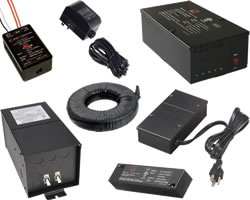
This information is presented in the Bruck catalog.
Transformers
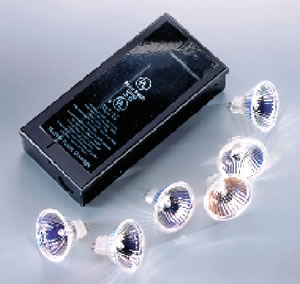
A transformer is required to transform the mains voltage (120V) to the low voltage (12V) that is required for the operation of low voltage lamps. The transformer may be wire-wound (magnetic) or electronic and both types are available with various features that dictate their application. Generally, electronic transformers have a high frequency output, are small in physical size and weight and often include features such as output voltage regulation and dimming capability.
These transformers are typically limited to applications where the connection to the LV lamp is less than 80" in order not to exceed the International Standards for EMV.
This limitation means that electronic transformers are typically used for small systems of up to 105W. The output frequency of magnetic transformers is 60Hz and can be used to feed LV lamps at distances of greater than 80" without EMV problems.
This makes them particularly useful for lighting track systems and for higher power output, typically up to 300W. The transformers need to be mounted close to the track system in order to minimize the volt drop through the power feed cable.
For this reason surface mounted and decorative remote transformers are typical. Inductive transformers are very reliable because the technology is very simple and traditional.
Dimming
All LV lamps can be dimmed to zero and all magnetic transformers can be dimmed using dimmers designed for inductive loads.
The dimmer must be rated to at least the rating of the transformer, e.g. 300W dimmer for 300W transformer.
Not all electronic transformers are dimmable and those that are require dimmers designed for this purpose so compatibility must be checked with the manufacturer.
LV Lighting System Loading
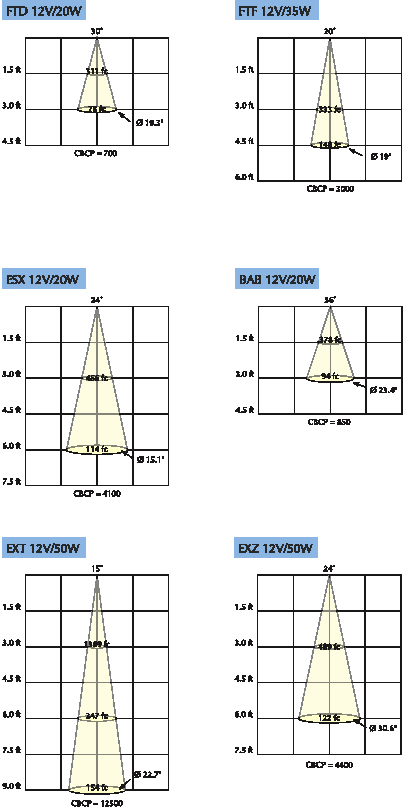
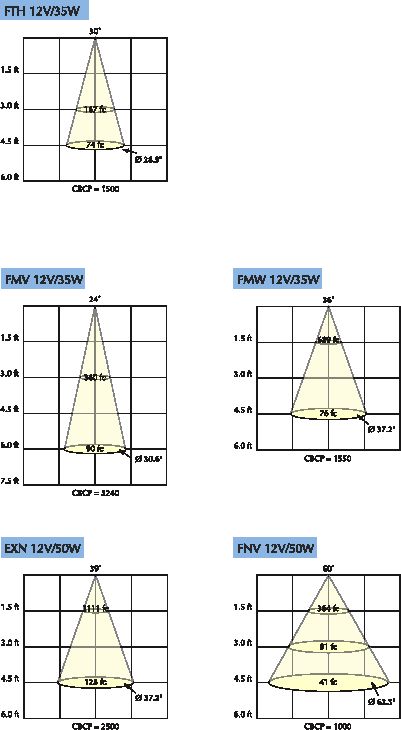
A 300W circuit can have a load of up to 6 x 50W lamps, 8 x 35W, 15 x 20W or combinations of different wattage lamps, which give a combined wattage of 300W.
Fundamentals of lighting using low-voltage halogen lamps
Lamps
 Bruck Lighting has long recognized the advantages of low voltage, halogen, and incandescent lamps.
These advantages are mainly due to the small size of the lamps. Compared to other light sources the filament is shorter and has a larger cross sectional area, which creates an almost dot shaped point of light.
The high luminous density of this point of light is ideal for channelling and directing with reflectors whose small size make them especially useful in display and accent lighting applications.
Advantages in brief
- Uniform white light throughout the whole service life.
- Excellent colour rendering, brilliant for fresh colours.
- High efficiency, more usable light at the same wattage and with long life - typically 4000 hours.
Note: All low voltage lamps distributed by Bruck are low-pressure versions and may be used in light fixtures without protective glass.
 Site Map >